
For participating personnel
Photo: Aksel Sandvik at Molde University College
The DSED procedure
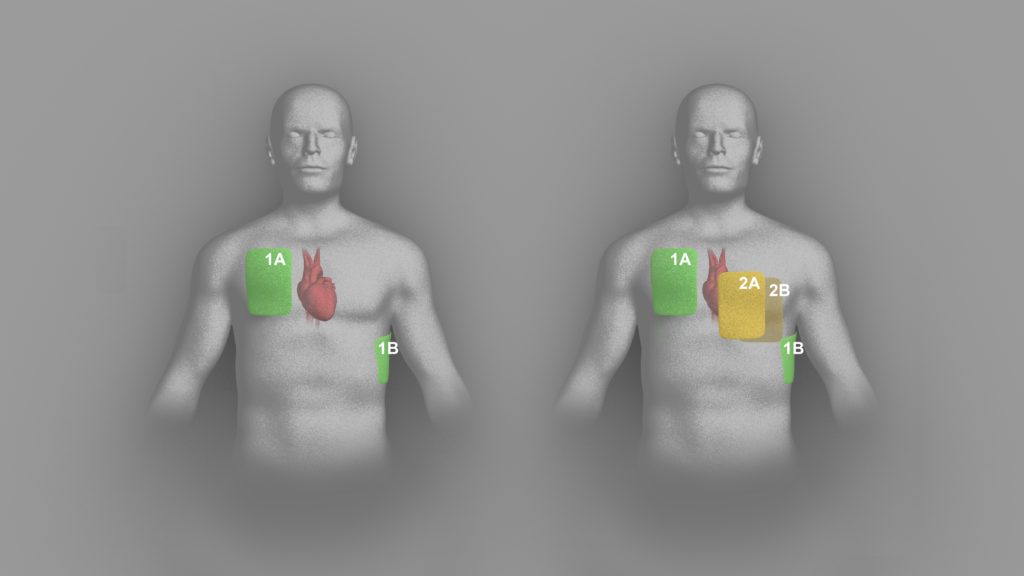
Double sequential external defibrillation (DSED) is a procedure that can be viewed as a continuation of standard cardiac arrest treatment and involves two defibrillators instead of one. Currently, the procedure is performed in ground ambulance services in United States of America, Canada and New Zealand, while implementation continues across the world. Several trials that research the use of DSED in cardiac arrest is ongoing.
In treatment of out-of-hospital cardiac arrest (OHCA), one defibrillator is set up with standard pad placement (anterior-lateral) and the other is set up with anterior-posterior (AP) pad placement. The pads in AP position are placed left of the sternum and beneath the left shoulder blade. Placement of AP pads is done as fast as possible during ongoing cardiopulmonary resuscitation (CPR). When both defibrillators are established, shock is delivered in rapid succession less than one second apart. All other treatment is according to existing guidelines.

Educational program and information
All personnel that participate in the study will undergo procedural training. The educational program will be held by project management members whenever new ambulance stations or ambulance personnel are added to the trial. The educational program will include a theoretical procedure briefing followed by scenario training on a mannequin. All personnel must complete this program before they can perform the procedure on study subjects.